THE COMPLEXITY OF THE HUMAN BRAIN is a feature no other organism can match. The number of achievements humans have made over the years is something no other organism can rival.
Humans have built technology strong enough to withstand the climate of Mars, cured deadly diseases, built and maintained entire civilizations, created 8,000+ languages, and created music and art. When it comes to human accomplishments, these are just the tip of the iceberg.
These remarkable accomplishments are possible due to a critical part of the human body: the brain. While all organisms have brains, the human brain’s complexity and size distinguish it from the rest. Why is the human brain so large and complex?
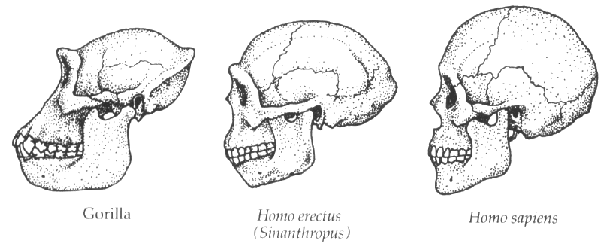
Evolution has taught us that humans evolved from apes. In fact, humans and apes share 98.8% of their DNA. If humans and apes are so similar, why is the average human brain 3x the size of an ape’s brain?
Incredibly, a single gene mutation has made all the difference. All muscles are made of proteins and proteins are made of genes. Apes and monkeys have a gene called MYH16. This gene codes for the protein myosin that is found in jaw muscle.
Scientists discovered a gene mutation in humans that occurred 2.4 million years ago. This mutation in the gene caused the protein myosin to become weaker. This caused the jaw muscles to weaken. Compared to primates, humans have a relatively weak jaw.
Due to this jaw mutation, the human brain is almost three times larger than a chimps brain. The skull is comprised of many small plates, and as the individual gets older, the plates slowly fuse together. In chimps, the skull fuses about three months after birth. In humans, the skull fuses around the age of 20.
As the jaw muscles weakened because of the mutation, the pressure on the sutures that connected the plates of the skull reduced. This resulted in the human skull fusing nearly 20 years after the fusion of an ape’s skull.
Since the gene mutation 2.4 million years ago, the brain has slowly tripled in size as the skull slowly expanded. Although mutations have a negative stereotype, if not for the small gene mutation, human achievements would be near zero.
One of my favorite quotes is, “From small acorns, mighty oaks grow.” The same can be said about various subjects, including gene mutations and large skulls. In science, the tiniest switches can make vital differences, hence the mutation 2.4 million years ago that changed our lives for evermore.
“From small acorns, mighty oaks do grow.”
– Unknown Author
 ev·er·more
Leave a comment